The "free" walking tour of Budapest was a great introduction to some of the major sites in the city. However, there were some areas that we didn't get to or weren't featured - and we had plans to "see it all" (within reason). Inconveniently, some locations in Buda were too far away or required additional transportation outside the city, therefore; we focused on everything Pest had to offer. Using a guide book and public transportation maps, we created our own sightseeing excursion.
 |
| Országház |
|
 |
| Hungarian Parliament Building |
|
 |
| Sadly closed to the public today |
|
Starting our tour, we took the Metro to the Hungarian Parliament Building. There are guided walk-throughs, but the times were inconvenient for our tightly packed schedule. When we arrived at Parliament the tour schedule was moot - the entire facility was closed to the public for the day for "in-session meetings." A slight damper on our parade, but we pressed on and visited the nearby 1956 Memorial - commemorating those who perished in the Kossuth Lajos tér Massacre. A public protest turned nightmare when citizens gathered against the government in the square - where they were fired up by the soldiers and government sworn to protect them. There are varying statistics about those slaughtered, but it is believed that between 300-800 people were killed on "Bloody Thursday" (the Hungarian government is still seeking information from survivors about what transpired that day). We returned to the Metro for a quick ride to our next point of interest, the Jewish Quarter.
 |
| Corridor parallel to Danube River |
|
 |
| Kossuth Lajos tér Massacre Memorial |
|
 |
| Firepower used against citizens on Bloody Thursday |
|
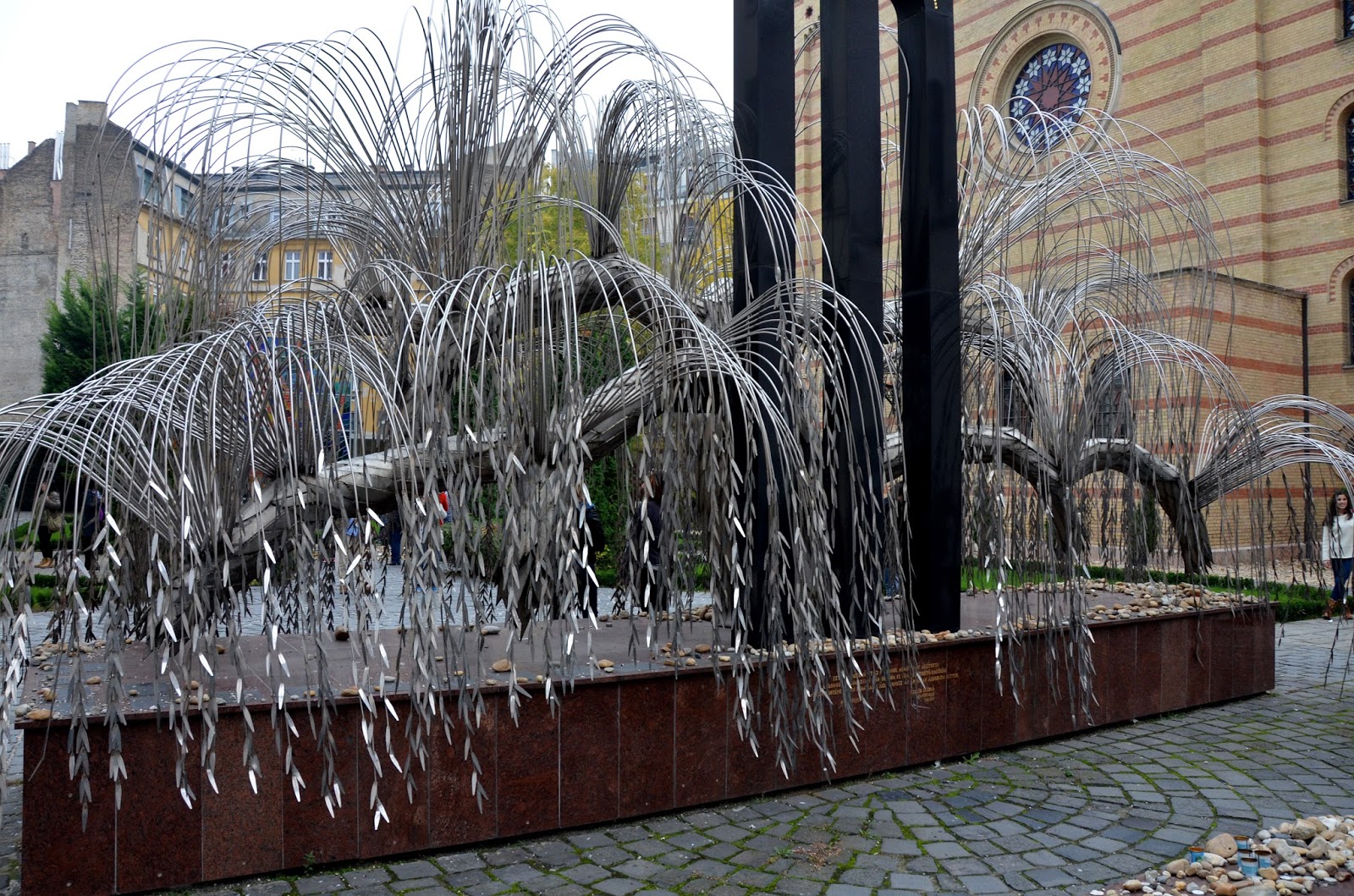
Stopping in Astoria, we walked the Pedestrian area and charted our course for Dohány Utcai, the location of the Dohány Street Synagogue. The Great Synagogue is the largest in Europe and has a capacity of up to 3,000 people. Unfortunately, when we arrived and passed through security, we discovered there was an €7 admission to go inside. We decided that we didn't want to pay, therefore; we walked around the building and continued onto the next item on our list, the old ghetto wall. However, the address provided by our guide book was inaccurate, we were led to a street full of restaurants. Later, we learned the wall was demolished in 2006 during construction, but a memorial was reconstructed in 2008 - presumably in a different location. Parliament was closed, the Synagogue had an admission, and a ghetto wall that didn't exist - not a very successful start to our day, but we moved onto Hero's Square.
 |
| The Jewish Quarter |
|
 |
| Dohány Utcai Zsinagóga |
|
 |
| Weeping willow memorial by Imre Varga |
|
Conveniently, the remaining attractions on our itinerary were all on the same Metro line and each had a corresponding stop. We began with the farthest one (well almost), Hösök tere, better known as Hero's Square. Here, there is a large statue flanked by two colonnades. The statue is often refereed to the tomb of the unknown soldier, but is a not a burial site, rather; a cenotaph (
similar to Frauenkirche's cenotaph of Emporor Louis IV in München). The statues lining the colonnades are important figures throughout Hungarian history - while those atop the structures represent war, peace, labor, and knowledge. We walked through the square, across a bridge to an area that appeared to be setting up for a festival. Sadly, it was the opposite, but found ourselves near the Museum of Hungarian Agriculture (Magyar Mezögazdasági Múzeum) and Vajdahunyad vára (castle). We made the most of our time and leisurely walked through City Park. To reward ourselves for the amount of exercise the past two days, we delved into the delights of a Turkish Baths.
 |
| Left colonnade - Labor and War |
|
 |
| Hösök tere - cenotaph |
|
 |
| Right colonnade - Peace and Knowledge |
|
 |
| Entering Museum of Hungarian Agriculture |
|
 |
| Magyar Mezögazdasági Múzeum |
|
 |
| Vajdahunyad vára |
|
Exiting the park, we inadvertently arrived outside our intended destination, the Széchenyi Gyógyfürdö és Uszoda (Széchenyi Thermal Baths). This is one of the famous bath houses of Budapest and largest in Europe - where we would indulge in the local culture (we had purchased a cabana ahead of time). Much to our dismay, we had to rent towels because the idea of carrying hotel towels around town seemed ridiculous. That may have not been an awful decision in retrospect, the rented cloth resembled a napkin more-so than a bath towel (and could not be exchanged for a dry one). Our time here was equally enjoyable and creepy - the relationship between age and size of swimming briefs was inversely proportional. The older the bathing Bloak, the significantly decreasing size of the swimwear - exponentially increasing the shudder factor. Fortunately, there are several pools of varying temperatures - making it easy to avoid what our eyes preferred go unseen. After an hour or two, we too looked old and wrinkly - it was time for us to continue with our day.
 |
| Széchenyi Gyógyfürdö és Uszoda |
|
 |
| Cupola inside Széchenyi Bath House |
|
 |
| Outdoor Springs |
|
 |
| Turkish Baths |
|
We got back on the Metro, and headed back to Magyar Állami Operaház (Hungarian State Opera). The Opera Metro stop is my favorite in the entire city, I briefly stopped to take pictures and enjoy the second-oldest Metro in the world, dating back to 1896 (London Underground is the oldest). A night ago, we saw Die Frau ohne Schatten, but I didn't haul my camera to the performance. The Opera House offers tours in the afternoon for a nominal price and an additional fee if you would like to take pictures (further charge if you want to see a small performance).

 |
 |
The beginning of our tour was similar to the chaos that started our "free" walking tour - a hoard of people milling about waiting to be given instruction. The groups sensibly split up by language, but the English group equaled the total of all the others combined. This made it difficult to listen if one wasn't close enough to the guide - one obnoxious member of our group even shouted, "I can't hear you," while our guide was speaking. The smaller the rooms became, the harder it was to hear as our group could barely fit inside the rooms. Instead of incessantly jockeying for position, we set off on our own adventures. I went to take pictures while blending with other groups and Julie disappeared on her own mission. Our endeavors paid dividends, while our faction squeezed into the Royal suite's hallway (the Red Salon) - we parted ways with our troop. My little space cadet had found something far more interesting, an unlocked suite to the theater. Shortly after I joined her, eight other sheep from our tour followed me and ruined what could have been a private concert.
 |
| Royal Box |
|
 |
| Grand staircase |
|
 |
| Statue of Pic'ma Noseus |
|
 |
| Magyar Állami Operaház |
|
 |
| Marble staircase columns |
|
 |
| Franz Liszt - Hungarian State Opera |
|
A night ago, during Die Frau ohne Schatten - Julie tried to coax me into upgrading our 12th row seats to a recently vacated private balcony after Act II. We sat in the box during intermission, but I later chickened-out and we clucked our way back to our original seats. We wanted to enhance our experience and find another box where we could enjoy the current rehearsal. Our tour ended on the second floor in a room that we heard very little about. Finally, the large group played to our advantage and we were able to abscond with the mass departure. While members made their way to the exit, we lagged behind and found another unlocked suite. The theater was empty, with exception to three people and the cast of the of Cosi Fan Tutte (Mozart). We were able to enjoy a private show for twenty minutes -
a production that involved no tire-pushing.
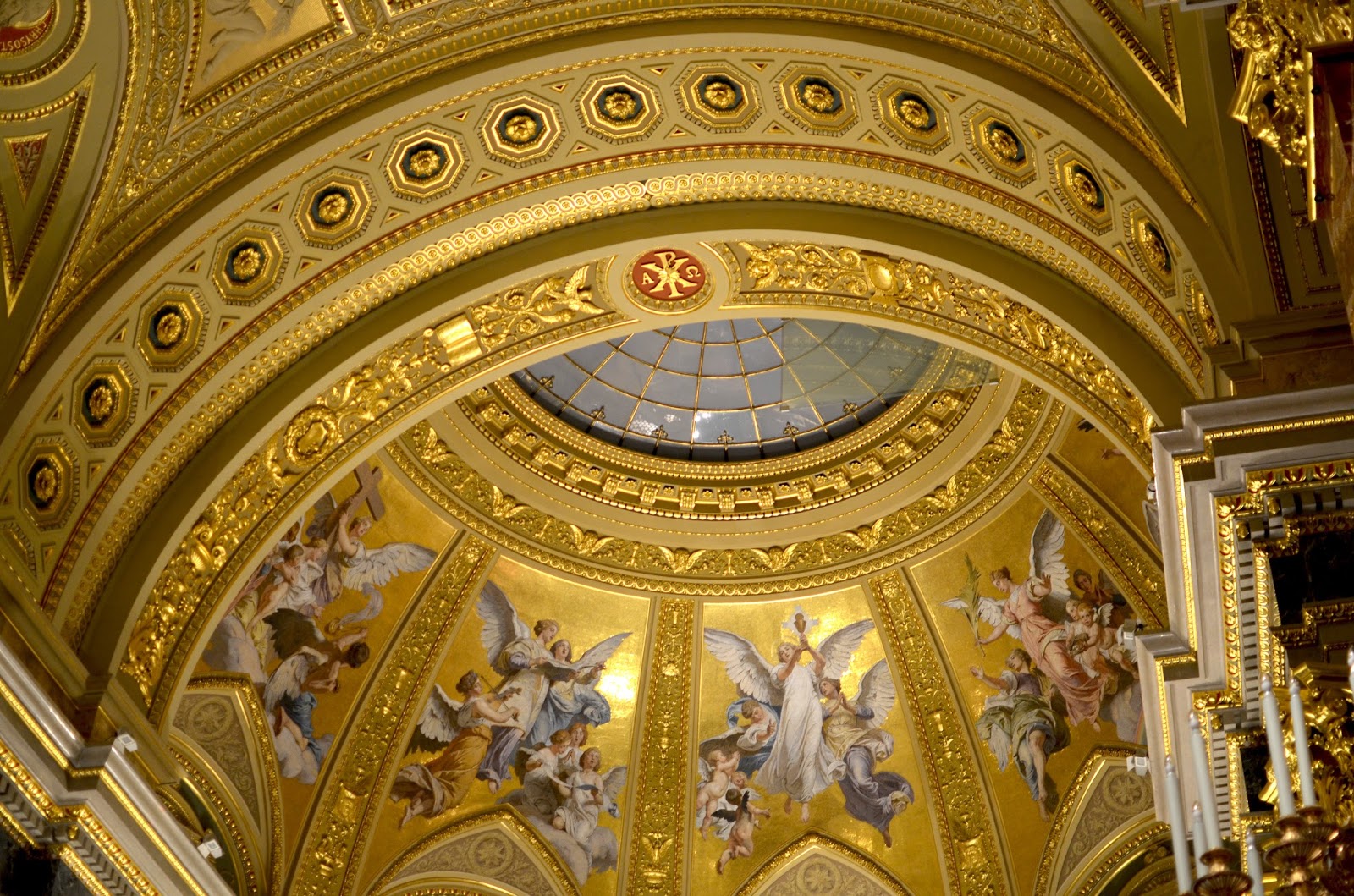
This unplanned venture conveniently bridged the gap to our final activity, an organ recital at Saint Stephen's Basilica. We have visited many churches in Europe - most of which are adorned with decadent organs, but we never hear them played. This gave us a rare opportunity to hear a short concert with some opera. there was a short set of eight songs* that would last forty-five minutes.
 |
| Saint Stephen's Cathedral at night |
|
 |
| Up-lighting |
|
After the show, we returned to the hotel, put our fancy pants on and went to the first-class restaurant we encountered the night of our arrival. Our table overlooked the Fisherman's bastion and had a glimpse of the Parliament Building. There was a small band playing classical music near the entrance - with a rogue violin player that would meander his way through the restaurant (fortunately, not in our area). For dinner, we indulged with both food and drink - spoke about the wondrous city of Budapest and how much we loved our visit.
Great sites, Great food, Great people, Great experiences - Go to Budapest
*Saint Stephen Cathedral Organ Concert
Performed by:
András Virágh - organ
Ildikó Szakács - soprano
Songs:
Tomaso Albinoni - Adagio in G minor
W. A. Mozart - Alleluja
J. S. Bach - Prelude and Fugue in C Major
Georges Bizet - Agnus Dei
J. S. Bach - Air
Franz Liszt - Choral
Charles Gounod - Ave Maria
J. S. Bach - Toccata and Fugue in D Minor (a pipe organ concert would be incomplete without this)